
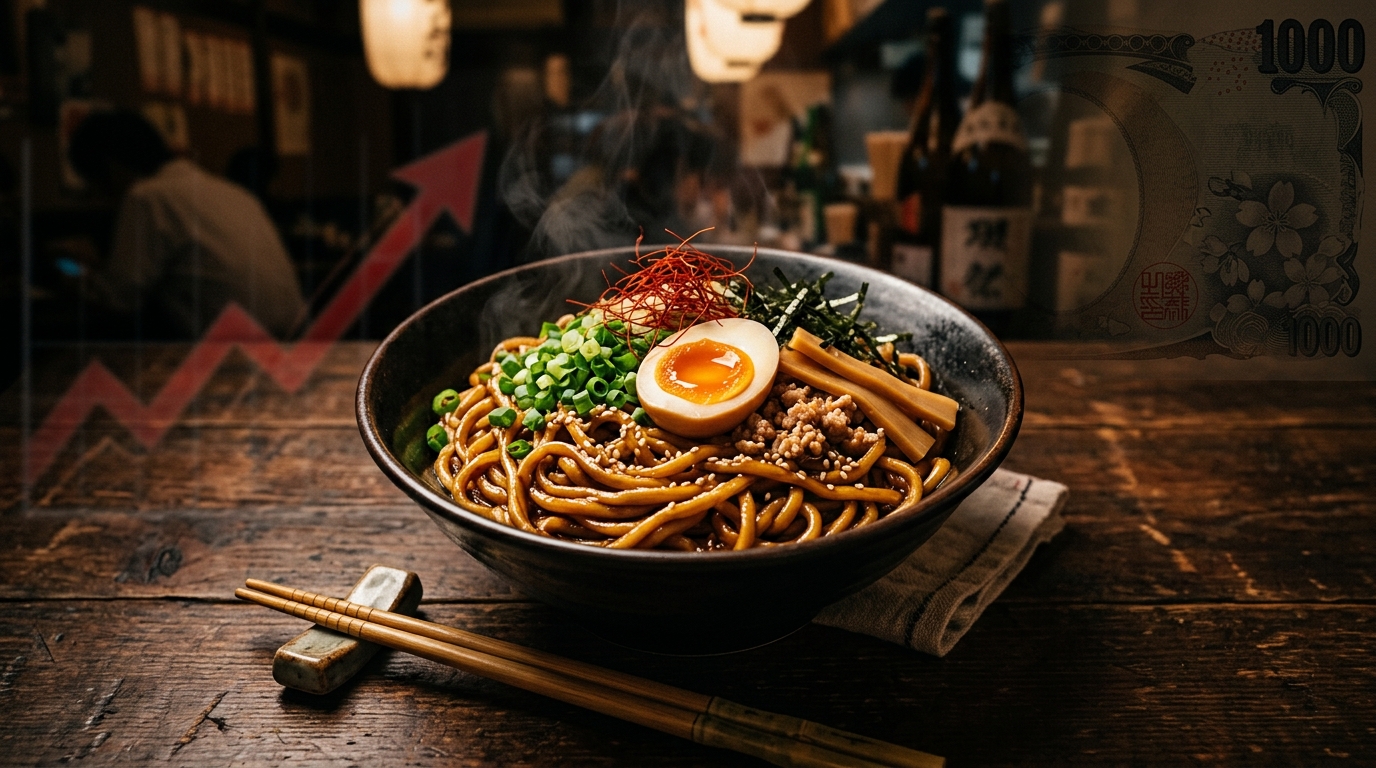
Earlier this week, Japan Times reported a number that's worth sitting with: 4,923 food and beverage items from 195 major Japanese manufacturers are set to increase in price this September. That's roughly three times the number of items that saw hikes in September of last year, and it's the highest single-month total in 2026 so far — the fourth-largest on record, according to Teikoku Databank, the research firm that tracks this every month.
Zoom out further and it's bigger than one month. Japan has now confirmed price hikes on 19,083 food and beverage items so far this year, putting 2026 on pace to cross 20,000 for the second year running. The causes are the usual suspects stacked on top of each other: a weaker yen making imports more expensive, higher crude oil prices tied to tensions in the Middle East, and rising logistics costs that hit everything from shipping containers to the last-mile delivery truck.
The category that got hit hardest is the one we buy from every week
Of everything on that list, seasoning products — soup bases, mayonnaise, sauces — accounted for the largest single category, at 1,959 items. Processed foods like frozen items and fish paste products came in second at 1,848. Kikkoman alone is raising prices on 107 household items this round, including a widely used soy sauce and a soy sauce-based soup base.
That's not an abstract headline for a restaurant like ours. Soy sauce, tare, seasonings, and specialty noodle imports are exactly the kind of line items that show up on our own supplier invoices every week. When a weaker yen and higher shipping costs stack on top of ingredient price increases at the source, it doesn't stay in Japan — it works its way through every kitchen that sources authentic Japanese ingredients, including ours.
"Price reductions are unlikely to spread among food manufacturers as the tough cost environment remains unchanged." — Teikoku Databank
Where this sits against our own numbers
We'll be straight with you, because we think that's more useful than staying quiet about it. At the beginning of this year, we raised prices by $1 across our menu — a decision driven by rising wages and food costs that had already been building for a while. That adjustment was made specifically so we could keep paying our team fairly and keep sourcing the ingredients that make aburasoba taste the way it's supposed to taste, without cutting corners.
$13.99–$14.99
That's where our core bowls have sat since that adjustment, and we don't have another price change planned right now. Given what's happening upstream in Japan's food supply chain this September, holding that line isn't guaranteed to be easy — but it's where we want to stay for as long as we possibly can.
We're not going to pretend a global ingredient cost story has zero effect on a small U-District restaurant. It does. Soy sauce, seasonings, and specialty noodles are core to what we serve, and when their cost moves in Japan, we feel it eventually too. What we can control is how long we absorb that before it shows up on a menu board — and right now, that's exactly what we're trying to do.
Why we'd rather say this than stay quiet
Most restaurants don't talk about ingredient costs at all — prices just quietly creep up on a menu with no explanation, and customers are left guessing whether it's inflation, greed, or something in between. We'd rather be the restaurant that just tells you what's actually happening. A weaker yen and rising logistics costs are real, they're hitting the exact ingredients we build a bowl of aburasoba around, and we've already made one price adjustment this year to deal with it responsibly. We're choosing to hold the line on $13.99 and $14.99 bowls for as long as the math lets us — not because it's easy, but because we think a fulfilling bowl of aburasoba at a fair price is worth protecting.
Back to Blog