
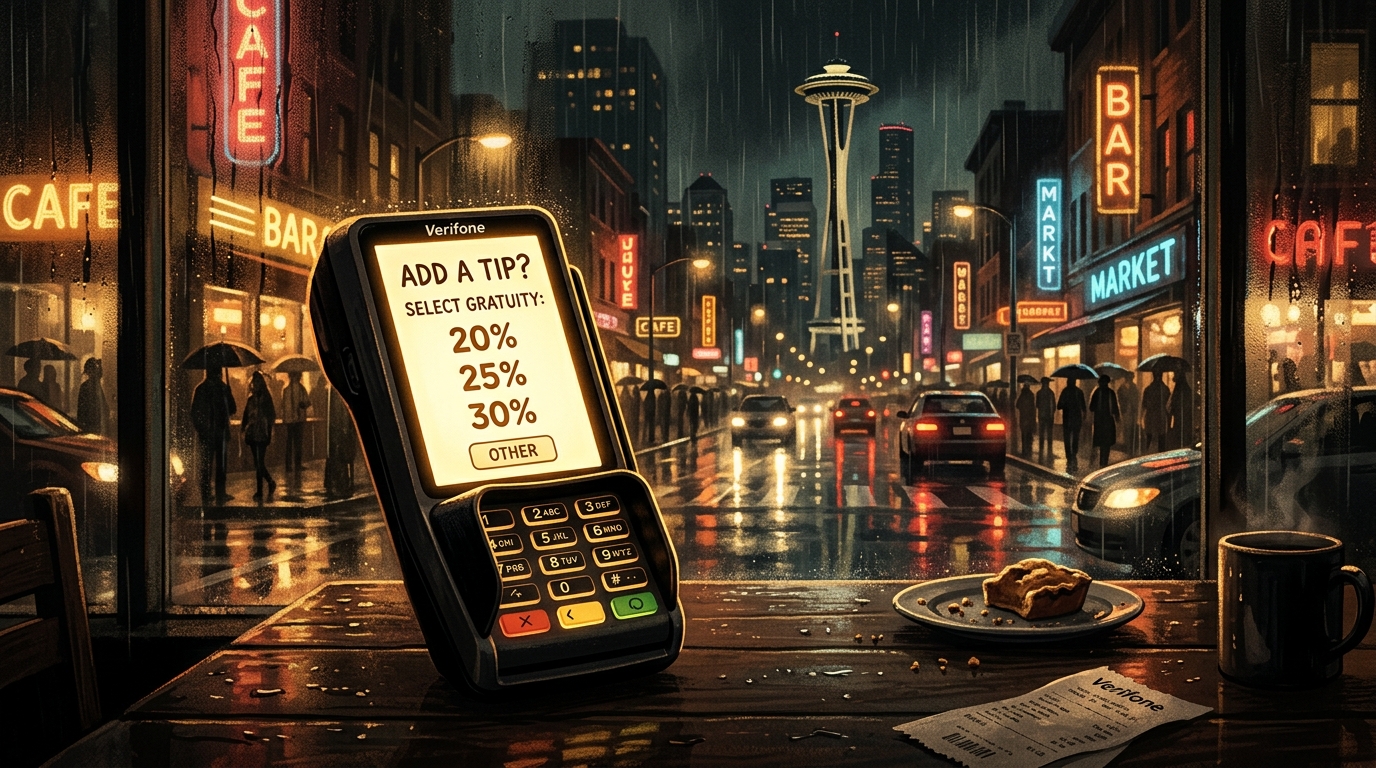
You’re at a coffee shop. You ordered a medium drip — no customization, no table service, no one refilled your water. You walk to the counter, tap your card, and a screen spins toward you. The options: 20%, 25%, 30%, or the increasingly passive-aggressive “No Tip.” Your barista is watching. The person behind you is waiting. You feel it: the pressure.
Welcome to tip fatigue — one of the most universally shared frustrations in American life right now. A 2025 survey found that nearly 89% of Americans believe tipping culture has gone out of control. Researchers call it tipflation. We’re now getting asked to tip at self-checkout kiosks, airport vending machines, and food trucks where a tablet just stared at you while you poured your own coffee. At some point you have to ask: who exactly are we tipping here? (Gas pumps are probably next. You’ve been warned.)
The good news: some restaurants are pushing back. Seattle — a city with a $20.76/hr minimum wage and a long history of progressive labor policy — has become a quiet hub for places that have ditched the tip model entirely, or made it genuinely optional. Here’s what’s going on, and where to find them.
How We Got Here: The Brief, Maddening History of Tip Creep
Tipping in America was originally a European import that most people hated — anti-tipping leagues in the early 1900s called it undemocratic, and several states briefly banned it. It survived, became entrenched, and got embedded in federal law: restaurants in most states can pay tipped workers as little as $2.13/hr, with tips expected to make up the difference. For decades, 15% was the norm at sit-down restaurants. Then payment terminals made it trivially easy to slap a tip prompt on any transaction. Now 20% is the baseline, 25% is “generous,” and a medium drip coffee comes with a touchscreen quietly judging you. The moral burden of paying workers fairly has been offloaded entirely onto customers — in public, under social pressure, one passive-aggressive “No Tip” button at a time.
Why Seattle Is Leading the No-Tip Movement
Seattle eliminated the tipped minimum wage entirely. As of 2025, every worker earns at least $20.76/hr, regardless of tips. The usual justification for the tip system — “it supplements a sub-minimum wage” — simply doesn’t apply here the way it does in most of the country. That’s opened the door for restaurants to try something different: some have eliminated tips and raised menu prices to reflect honest labor costs. Others have said tips are optional and meant it. A few have put up signs. Actual signs. In the restaurant. Saying no tip is needed. In 2026, that qualifies as radical transparency.
Tipping-Optional & No-Tip Restaurants in Seattle (2026)
These places have either eliminated tipping, built wages into menu prices, or made tipping genuinely optional — not just “technically optional” while a giant 30% button stares you down.
-
Off Alley
A natural wine bar and small-plates spot that has made it explicit: their prices reflect a fair living wage for all staff, and tips are not required. No tip line, no social pressure. The menu does the talking.
-
Flying Lion Brewing
This neighborhood brewery pays staff fairly and has removed the tip option entirely — there isn’t even a line for it at the register. Order a pint, pay the price, done.
-
Molly Moon’s Homemade Ice Cream
Seattle’s beloved scoop shop concluded that tipping creates inequitable, unstable income and moved away from it. Staff are paid a living wage. If you’ve ever felt weird tipping (or not) for a scoop of ice cream, you’re welcome.
-
Ada’s Technical Books & Café
The bookshop cafe in Capitol Hill has been tip-free for years — well ahead of the current conversation. Specialty coffee, good vibes, no guilt screen.
-
Windy City Pie
The deep-dish pizza institution updated both its menu prices and staff compensation to reflect the real cost of labor. No surcharges, no tipping prompts. Just really good deep dish.
-
Cafe Remix
A rare bird: Cafe Remix advertises a “no tax, no tip” experience. What you see on the menu is what you pay. Full stop.
-
Upper Bar Ferd’nand (Matt Dillon)
Chef Matt Dillon’s wine bar operates as a “no tip / no service charge house” — menu prices are fully inclusive. One of the few full-service restaurants in Seattle to take this position explicitly.
-
Lionhead (Jerry Traunfeld)
From James Beard Award-winning chef Jerry Traunfeld, Lionhead’s menu prices include service. Any additional gratuity is entirely at the diner’s discretion — not prompted, not expected.
-
Slurp Station Aburasoba
Seattle’s first aburasoba restaurant doesn’t just say tipping is optional — they mean it. The register defaults to no tip, the tip system is hard-capped at 18% (you literally cannot go higher), and signs around the restaurant make the policy explicit: they pay their staff well, so no tip is expected. No guilt screen. No passive-aggressive “No Tip” button. Just good noodles and a refreshingly honest checkout.
The Bottom Line
Tip fatigue is real, and it’s not irrational. A system where customers bear moral and financial responsibility for workers’ wages — enforced by social pressure at a touchscreen — was never a great design. Seattle’s labor landscape has given restaurants here more room than most to try something different, and some are genuinely taking it.
One local example worth calling out: Slurp Station, the aburasoba spot in the U District, takes tip-optional seriously in a way most restaurants don’t. The tip system is capped at 18% max — you literally cannot tip more even if you wanted to. When you order in-store, the default is no tip selected. And signs around the restaurant are explicit about it: they pay their staff a good wage, so no tip is expected. Not “we technically accept tips,” not a soft suggestion — just a straightforward acknowledgment that the meal is priced fairly and the staff is taken care of.
“No tip expected. We pay our staff well.” — Actually posted in the restaurant. In 2026, this is apparently a bold move.
The list above is a starting point, not exhaustive. Policies change, restaurants close, and what counts as “optional” varies. If transparent pricing matters to you, check a restaurant’s website or just ask. You’ve earned the right to ask — especially after years of watching tip screens evolve from a courtesy into a guilt machine.
Back to Blog